No one has helped me more in living out the Christian faith in this fallen world than Abraham Kuyper’s writings on the doctrine of common grace.
In certain sects of Christendom, this world (including non-Christians) is viewed as the enemies of Christ and Christians. As a young believer, I often wondered, “Then how do Christians love our neighbors and love our enemies?” The typical response I received was, “Do not love the world nor the things in the world. If anyone loves the world, the love of the Father is not in him” (1 John 2:15). As I grew older in faith, I didn’t know how to reconcile that verse with the following questions: What if I love to study law and enter the life of politics? What if I love politics? What if I love making money and am good at it? What if I enjoy living a comfortable life in this world?
Then, I discovered Kuyper. Here’s a taste of what I found:
“If God is sovereign, then his lordship must extend over all of life, and it cannot be restricted to the walls of the church or within the Christian orbit. The non-Christian world has not been handed over to Satan, nor surrendered to fallen humanity, nor consigned to fate. God’s sovereignty is great and all-dominating in the life of that unbaptized world as well. Therefore, Christ’s church on earth and God’s children cannot simply retreat from this life. If the believer’s God is at work in this world, then in this world the believer’s hand must take hold of the plow, and the name of the Lord must be glorified in that activity as well.”
Understanding the doctrine and implications of common grace as a theology of public responsibility and cultural engagement rooted in Christians’ shared humanity with the rest of the fallen world has profound results.
Richard Mouw states, “Kuyper is arguably the most prominent proponent of the idea of a cultural mandate issued by God to human beings in the first chapter of Genesis.”
I affirm that, too. For that reason, I spent several weeks unpacking various implications in Genesis 1 and 2 in my sermon series “Theology of Vocations.” I wanted my audience to know they could serve God meaningfully wherever or whatever vocational fields God placed them (whether in technology, medicine, public health, science, education, art, etc.). So often, evangelism or sharing the Christian faith happens naturally and organically within those vocational fields. As a result, I met many non-Christians brought to church by their Christian co-workers who heard and understood the doctrine of common grace (and its implications).
I highly recommend this book and the series (collected works in public theology).
This year, I had the privilege of getting hold of several books published recently or just hot off the press. I’m always amazed that sometimes good books come in small sizes.
“It is safe to say that this book is one of the richest, clearest, and most persuasive single-volume accounts of Reformed theology ever produced for a wide audience.”
This is a welcoming addition if you have Herman Bavinck’s (1854-1921) four-volume Reformed Dogmatics (1906-1911).
Quoting William Law (1686-1761), a Church of England priest, said, “Would you know him who is the greatest saint in the world? It is not he who prays most or fasts most; it is not he who gives most alms, but it is he who is always thankful to God, who receives everything as an instance of God’s goodness and has a heart always ready to praise God for it.”
My wife and I have been reading it together for the past two years during family devotion.
This short little book answers several contemporary issues, such as: Is same-sex attraction a sin? What’s the difference between gender dysphoria and transgenderism? Is it OK to call yourself a “gay Christian?” Can I attend a gay wedding? Is it OK to use people’s preferred pronouns?
In the foreword, Sinclair Ferguson writes that preaching is bringing “an awareness of the presence of God” to hearers. That statement alone is worth the money. As a young preacher, I may not have understood those words as I do now. It truly defines theocentric preaching and what is greatly missing in today’s “preaching.”
I often read and meditate on the words of the past for my own sanctification, edification, and instructions to my soul. That’s because God’s truths are timeless—they are the same yesterday, today, and tomorrow. I now understand why the saints of the past were so robust in their faith and lives.
What does the Bible have to say about brain disorders, chemical imbalances, Ritalin, alcoholism, and other addictions as a disease? This is the revised and updated edition from 1994.
This small little book concisely summarizes what Reformed theology is. I used to believe that being a five-point Calvinist or affirming the five “solas” is what being “reformed” meant. Little did I know. It wasn’t until about 20 years ago, when I served in the Upper Midwest, that I learned what “reformed” meant. In God’s good providence, I befriended some good ministerial brothers from the United Reformed Churches in North America who directed me to books and resources and many hours of fruitful discussions. For that, I am forever grateful. This book offers a good introduction and summary of what Reformed theology is.
If Jonathan Master’s short book Reformed Theology is for someone new to the topic, this one is for someone who is beyond an introductory level, though this book is relatively easy to read. In fact, the author is a pastor, though he is an expert in the subject. Not too many books are written by pastor-theologians or theologian-pastors. This resource is good for Sunday School, Bible Institute classes, discipleship groups, or personal devotion.
The last Augustine’s book I read was in 2015. This one is much longer (over 3 times longer than Confessions). I was teaching a class on the fall of the Greek and Roman Empires. So, I wanted to brush up on the topic and read a primary source. Also, with all the political election rhetoric this year, this book reminded me that the destruction of Western culture isn’t that farfetched idea and that the only hope is in the City of God.
At the 2007 Shepherds’ Conference, John MacArthur gave a message entitled “Why Every Self-Respecting Calvinist Is a Premillennialist.” At the onset of A Case for Amillennialism, Riddlebarger responds to MacArthur’s claim that the framers of the Canons of Dort (where the term “Five Points” comes from) were all amillennials (16). According to the author, this book aims to point out the historic Protestant understanding of the millennial age (22).
“Remember the deeds of our fathers and mothers, remember the rock from which we were hewn, and the quarry from which we were dug. It can help us understand why our world is the way it is – how it became Western, Educated, Industrialized, Rich, Democratic, Ex-Christian, and Romantic, not least through the transformation of 1776 – and how to love, live, and thrive in it” (15).
“Next generations will not give Christianity a second thought if it seems lifeless, rote, and uninspiring. They will only get serious about the Christian faith if it seems like something seriously worth their time. You can have formal services, so long as you do not have formalism. You can have casual services, so long as you do not approach your faith casually” (4-5).
When we read of the people and their stories in the Bible, they are really our stories – stories of sin, rebellion, disobedience, and foolishness. According to 1 Cor. 10:11, “Now these things happened to them as an example, and they were written for our instruction.”
The word “rest” is mentioned about twelve times just in this text alone. Such a repetition is for the purpose of emphasis, and the main point is that the congregation of Israel will not enter into God’s rest. And the reasons that are given in the text are followed with the words “because” – i.e., because of unbelief (3:19), because it was not united by faith in those who heard (4:2), and because of disobedience (4:6). Although these three reasons may seem to refer to three separate problems, they all refer to the same issue but says in three different ways.
The Scripture warns over and over again that all sins have consequences. Some are greater than the other. And the sin of unbelief is no light matter because it has devastating effects individually and corporately.
No sins have only a personal effect. The consequences of every sin go beyond private or personal. For our first parents, their sin led to the consequence of the entire humanity. David’s “personal” sin had costed national consequences. And for the people of Israel, their sin affected the entire generation of their congregation and the next generation.
The Story of Israel’s Deliverance
The story of God delivering Israel begins with who God is in Exodus 3, namely that he is all-knowing and all-powerful (vv. 7-9).
Ex. 3:7 The LORD said, “I have surely seen the affliction of My people who are in Egypt, and have given heed to their cry because of their taskmasters, for I am aware of their sufferings. 8 “So I have come down to deliver them from the power of the Egyptians, and to bring them up from that land to a good and spacious land, to a land flowing with milk and honey, to the place of the Canaanite and the Hittite and the Amorite and the Perizzite and the Hivite and the Jebusite. 9 “Now, behold, the cry of the sons of Israel has come to Me; furthermore, I have seen the oppression with which the Egyptians are oppressing them.
This is the preview of the gospel. This is the NT gospel hidden in the OT. The gospel begins with God. And the story of God redeeming Israel begins with God initiating to save. And verse 8 is the preview of God coming down as man, Christ Jesus.
The notion that the good news of God redeeming Israel begins with who God is, namely that he is all-powerful and all-knowing is nothing new. That’s because the first three chapters of Genesis demonstrate that he is omnipotent and omniscient. And God in his mercy acted to save the people of Israel. According to Exodus 12:40, they were in that terrible condition for 430 years!
So, how was God planned to deliver the people out of that terrible burdensome condition? By choosing and sending Moses (3:10).
Through Moses, God demonstrated his power, established directions, structure, and law and order in the congregation. Through Moses, God also demonstrated his provision and protection. Through Moses, God spoke.
But what did the congregation do? Here’s just one out of many examples: 15:22-26.
What does the sin of unbelief look like?
Failing to trust God’s provision in Moses and his leadership. Whatever and however Moses led the people was not based on his feelings or his academic training but based on what God said. Moses simply functioned as God’s prophetic voice. So, when the people complained against Moses, they complained against the authority of God’s word.
Complaining/murmuring. To complain is ultimately to question God’s character, his sovereignty. To complain is ultimately failing to trust God. To complain is to imply that the complainers know what’s better for them than God, his plans, and his means. To complain is to fail to believe God, his promise, his plans, and his means. That’s what unbelief produces and shows! That’s what the fruit of unbelief looks like!
Another example of the fruit of unbelief is seen in Numbers 12:1-9; 14:1-4; and 16:1-3 (vv. 31-35 is what happens as a result). The rebellion of Korah is so significant to God that he mentions this as a warning in Jude 11, “Woe to them! For they have gone the way of Cain, and for pay they have rushed headlong into the error of Balaam, and perished in the rebellion of Korah.”
Was Moses perfect? No. But he was God’s perfect choice at that time. Does God make mistakes? Does God make mistakes in his plans? Didn’t God not know what’s best for the congregation of Israel?
Seriousness of Unbelief
The sin of unbelief produces the sin of ungratefulness, which manifests in complaining. The sin of unbelief is a serious sin and has a big and devasting results as you can see. O, how I pray that all professing Christians would wake up and see this as a serious sin. That’s why I preached not too long ago from Ephesians 5, especially verse 20, “always giving thanks for all things” – which I believe is one of the most important sermons for all Christians to hear.
What happened to them?
Aa a result, many died in the wilderness. God does not play around with the sin of unbelief because that directly assaults the heart of God’s character. In addition, the entire congregation wandered around in the wilderness for 40 years! Many could not enter into the promised land.
This is why Hebrews 3 and 4 warn us today why people will not enter into his rest and rob of themselves of God’s blessings (cf. 4:2-3, 6). And this is what the sin of unbelief looks like and what it does.
What Now?
Repent. According to 1 Cor. 10:11, “Now these things happened to them as an example, and they were written for our instruction.” The people in the Bible and their stories cannot be treated indifferently because they are our stories.
Listen to the exhortation in Hebrews 4:14-16.
Therefore, since we have a great high priest who has passed through the heavens, Jesus the Son of God, let us hold fast our confession. 15 For we do not have a high priest who cannot sympathize with our weaknesses, but One who has been tempted in all things as we are, yet without sin. 16 Therefore let us draw near with confidence to the throne of grace, so that we may receive mercy and find grace to help in time of need.
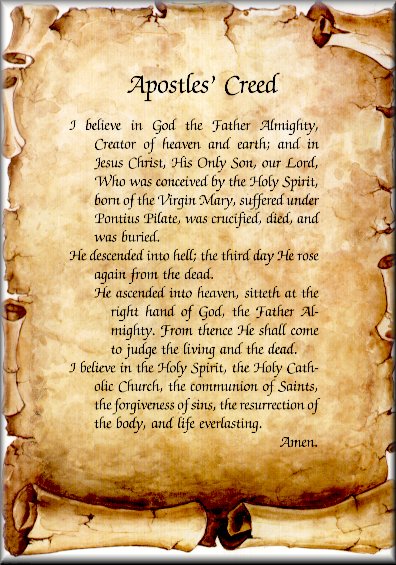
According to the Heidelberg Catechism, the Apostles’ Creed is divided into three parts:
Q. 24 How are these articles divided?
A. Into three parts: God the Father and our creation; God the Son and our deliverance; God the Holy Spirit and our sanctification.[1]
1. Trinitarian-Focused
Already mentioned, it is Trinitarian-focused. That is because, as Shuster says, “Christian faith is trinitarian faith.”[2] Shuster rightly observes that many contemporary songs today focus on only one member of the Trinity, unlike many old hymns.[3]
Shuster says:
A right understanding of the Trinity, then, is absolutely critical to soundness both in worship and in doctrinal exploration, for what one believes about the basic nature of God underlies everything else.[4]
2. Christological
Most words are spent focusing on the Son, Jesus Christ. This is because Christology’s very nature was questioned and erroneously taught by many heretics at the time, such as Marcion and the Gnostics.[5]
The order of the AC: 1) the Trinity, 2) the creation, 3) the incarnation, 4) the Holy Spirit, 5) the church, 6) the forgiveness of sins, and 7) the Christian hope.[6] Similarly, this is how most systematic theology books are written in that order.
3. The Catholicity of Christians
Some of the Criticisms Against the AC
1. The AC is too brief
Responding to the brevity of the AC:
The AC is a brief statement of faith. It summarizes the main points of what Christians believe. McGrath says, “It is not exhaustive, nor is it meant to be.”[7]
Brevity is not a bad thing, especially summarizing or condensing a long history. This is not to say that details are unimportant, but to communicate something in short, we often say, “To make the long story short.”
“Brevity is a virtue in the historian.”[8] The authors of the creed were historians, just as every Christian is (or ought to be) a historian. That’s because the gospel is a history. It deals with real, factual, and objective events that took place in history.
And since the gospel is a history or history of redemption, the one who is telling the history must get the facts right but without telling every exhaustive detail. “The historian, moreover, must make his work readable and interesting, without violating truth.”[9]
Since the authors of the creed were historians, they understood what it meant to be a good historian; namely, he must comprehend the importance of fidelity and justice. That is, is the story accurate? Did it really happen? Is it real and truthful? Also, as a teller of a historical count, is what I’m saying doing justice to the people that I am involved within the story? Also, to be a good historian, he must master the sources and arrange the material as in composition.[10] That’s what the author(s) of the creed did.
2. The AC leaves out essential doctrines and includes nonessentials
MacArthur says in the Foreword of Mohler’s The Apostles’ Creed:
In reality, the creed leaves out essential doctrines like the authority of Scripture, the depravity of man, the deity of Christ, and the means of salvation: justification by faith. It also contains nonessentials like the role of Pilate and the descent to hell.[11]
I beg to differ that the mention of Pilate and the descent to hell are “nonessentials.” Jesus is historical. Christianity is historical. The gospel is historical.
Final Thoughts
The AC did not come into existence all at once but was built up from time to time.[12] As I already pointed out, I see not only the beauty of the AC but also the necessity to teach it to God’s people more than ever.
[1] The Heidelberg Catechism.
[2] Marguerite Shuster, “The Triune God” in Exploring and Proclaiming the Apostles’ Creed, edited by Roger E. Van Harn (Grand Rapids: William B. Eerdmans Publishing Company, 2004), 2.
I want to begin by recapping what was taught on last Lord’s Day. Last week I talked about not only the beauty of the Apostles’ Creed (AC) but also the necessity to teach it to the church today than ever. A creed is simply a statement of what one believes. According to the Bible, the creed refers to “the form” (KJV), “the pattern” (ESV), “the standard” (NASB) of “the sounds words” (cf. 2 Timothy 1:13).
ESV: Follow the pattern of the sound words that you have heard from me, in the faith and love that are in Christ Jesus.
NASB: Retain the standard of sound words.
KJV: Hold fast the form of sound words.
And one of how the church can follow the pattern of the sound words, retain the standard of sound words, and hold fast the form of sound words is to confess them together or verbally express them together—the verb to confess means to agree or say the same words.
Also, we looked at some of the creedal statements in the Bible that the church has been confessing throughout its history. For example:
Deut. 6:4 “Hear, O Israel! The LORD is our God, the LORD is one!
1 Cor. 8:6 yet for us there is but one God, the Father, from whom are all things and we exist for Him; and one Lord, Jesus Christ, by whom are all things, and we exist through Him.
Philippians 2:11 Jesus Christ is Lord.
All that to say, we were introduced to the definition of what a creed is and then looked at some examples of the creedal statements in the Bible.
Lastly, we ended our time together by answering what is the Apostles’ Creed, which I said, the AC is simply a common summary of the Christian faith. The keywords are common and summary. That is to say, many churches throughout the world (past and present) commonly use it, and that the AC is accepted as the common summary of the Christian faith.
So, what I just said up to this point is a brief recapping of the last week’s message.
This morning, I want to answer two questions: 1) why is the AC important, and 2) what is the purpose of the AC? And if time allows, I want to make some critical observations of the AC and make two rebuttals against two common criticisms for the AC.
Why is the Apostles’ Creed Important?
The creed is the distinguishing badge of Christianity.[1] In other words, to believe the Apostles’ Creed is to accept the most basics of the Christian faith. The Apostles’ Creed brings true believers together and separates those who do not believe. In his introduction, Al Mohler says, “All Christians believe more than is contained in the Apostles’ Creed, but none can believe less.”[2] Also, “The Apostles’ Creed stands as a landmark of orthodoxy to guide the church.”[3]
Venema posits that one of the contributing factors for the absence of discernment and biblical understanding today is neglecting the church’s creeds and confessions. Historically, the believers were traditionally taught the Scriptures in terms of the summaries provided in the creeds or the confessions.[4]
The Purpose of the Creed
1. Catechetical Function
Mohler offers seven reasons why the AC is useful: 1) the creed defines the truth, 2) it corrects the error, 3) it provides rules and standards for God’s people, 4) it teaches the church how to worship and confess the faith, 5) it connects us to the principle of our fathers, 6) it summarizes the faith, and 7) it defines true Christian unity.[5]
J. I. Packer likens it to a “simplified road map.”[6] Specifically, a simplified gospel.[7]
According to McGrath, the AC is an ideal starting point for a consolidating grasp of one’s faith.[8]
2. Protects the Church from Heresies
No creeds or confessions can ever provide 100 percent heresy proof in the church. However, the AC can undoubtedly set a doctrinal perimeter of protection. The early church responded against many heresies, such as the Gnostics and Marcion. The AC was used to distinguish true believers from those who followed various heresies.[9]
3. Subscription and Accountability for Christian Leaders
According to McGrath, the AC was used as a test of orthodoxy for Christian leaders.[10] The purpose is juridical.[11]That means the office-bearers in the church are held accountable and judicially judged if they deviate from the teachings of the creed and confession that they pledged to subscribe to. When was the last time you heard of a church or church denomination stripping the church officers (pastors, elders, deacons) from their positions because they could not teach or defend the AC?
4. Baptism
According to McGrath, the AC was used as a confession of faith for the converts’ baptism.[12] During the baptism, the candidate was asked three questions:
Do you believe in God the Father Almighty?
Do you believe in Christ Jesus, the Son of God, who was born of the Holy Ghost and of Mary the virgin, who was crucified under Pontus Pilate, and died, and rose again at the third day, living from among the dead, and ascended unto heaven and sat at the right of the Father, and will come to judge the quick and the dead?
Do you believe in the Holy Ghost, the holy church, and the resurrection of the flesh? [13]
5. Christian Worship
The AC was used as part of the Christian liturgy.[14] There are threefold reasons: 1) a summary of the Christian faith, 2) recognize and avoid inadequate or incomplete versions of Christianity, 3) to believe is to belong.[15]
6. Public Statement of Faith (and Denial) that is both Local and Universal
According to Venema, the AC serves a “declarativepurpose,” to express some kind of statement of faith publicly what the church believes.[16] Also, by affirming, such affirmation implies what it denies.[17] It is double-edged. Like the sacraments, the AC holds out both blessing and sanction.[18]
7. Education and Entrance to Church Membership
The creed is an excellent educational tool. Venema says the creeds and confessions are “an indispensable instrument for the instruction of those who are admitted into the fellowship of the church through profession of faith.” Moreover, “From the earliest period of the church’s history, the creed served as a basic tool for catechesis, for the instruction of the faithful in the teaching of Scripture with a view to admission into the church’s membership.”[19]
8. Liturgical
Historically, the churches used the AC as part of their worship. The AC was used in baptisms, the Lord’s Supper, and receiving new members into the church.
To watch this sermon, you may click the video below:
[1] Witsius, Sacred Dissertations on the Apostles’ Creed, Vol. 1, 16.
[2] Albert Mohler, The Apostles’ Creed: Discovering Authentic Christianity in an Age of Counterfeits (Nashville: Nelson Books, 2019), xvi.
I grew up reciting the Apostles’ Creed (hereafter AC) as a young boy. It was my mom’s wish. Also, the AC was a regular part of the liturgy, where our family worshipped. The church belonged to the denomination of the Christian Reformed Church. As a child, I did not enjoy nor see the benefit of reciting the AC because it seemed boring and archaic, other than it pleased my mom and my pastors. However, now as an adult and a Christian minister, I see not only the beauty of the AC but also the necessity to teach it to God’s people more than ever.
The reasons why it is necessary to teach the AC today than ever have already been well documented in many books throughout various denominations, such as Presbyterian, Reformed, Baptist, broad evangelicalism, and even Roman Catholic.[1] Many agree and decry that we live in an anti-confessional and anti-creedal age. Some of the reasons are devaluing the past, overt consumption of consumerism, mysticism, pragmatism, and anti-authoritarianism – all of which are rampant in many contemporary churches.[2] For instance, many evangelicals have been taught to say, “I don’t need creeds; I just need the Bible,”[3] which is ironic because such a statement itself is creedal.
The word “creed” derives from the Latin credo, which means “I believe.”[4] A creed is simply a statement of what one believes. Hence, to say, “I don’t need creeds; I just need the Bible” is a self-refuting statement because such a statement itself is a creedal statement though it is a very poor and unsound creed. Creed in the Bible refers to “the form” (KJV), “the pattern” (ESV), “the standard” (NASB) of “the sounds words” (cf. 2 Timothy 1:13).
ESV: Follow the pattern of the sound words that you have heard from me, in the faith and love that are in Christ Jesus.
NASB: Retain the standard of sound words…
KJV: Hold fast the form of sound words…
And the verb in the original language is imperative. Hence, this is not God’s suggestion but God’s command for the church. So, this is not an option for the church.
Some of the Biblical Examples
Rom. 10:9-10 that if you confess with your mouth Jesus as Lord, and believe in your heart that God raised Him from the dead, you will be saved; for with the heart a person believes, resulting in righteousness, and with the mouth he confesses, resulting in salvation.
Exegetically, the verb to “confess” (homologeses) means saying the same words. Here Paul is making a credal acclamation.[5]
Notice the connection between confessing with the confessor’s mouth. Confession is not something that is done intellectually alone, but it also needs to express verbally. Fitzmyer says, “One must utter the basic Christian confession of faith and mean it” (emphasis mine).[6] Moreover, there always have been correlations between believing and confessing.[7]
Just in those two verses alone, there are creedal statements, such as “Jesus is Lord” and “God raised him from the dead.” There are other creedal statements in the Scripture. For example, “Hear, O Israel: the Lord our God, the Lord is one” (cf. Deut. 6:4) and 1 Corinthians 8:4-6 (can you guess creedal or theological statements in the passage?)
1 Cor. 8:4-6 Therefore concerning the eating of things sacrificed to idols, we know that there is no such thing as an idol in the world, and that there is no God but one. 5 For even if there are so-called gods whether in heaven or on earth, as indeed there are many gods and many lords, 6 yet for us there is but one God, the Father, from whom are all things and we exist for Him; and one Lord, Jesus Christ, by whom are all things, and we exist through Him.
Some other biblical examples are:
Eph. 4:4-6 There is one body and one Spirit, just as also you were called in one hope of your calling; one Lord, one faith, one baptism, one God and Father of all who is over all and through all and in all.
Philippians 2:5-11 Have this attitude in yourselves which was also in Christ Jesus, who, although He existed in the form of God, did not regard equality with God a thing to be grasped, but emptied Himself, taking the form of a bond-servant, and being made in the likeness of men. Being found in appearance as a man, He humbled Himself by becoming obedient to the point of death, even death on a cross. For this reason also, God highly exalted Him, and bestowed on Him the name which is above every name, so that at the name of Jesus EVERY KNEE WILL BOW, of those who are in heaven and on earth and under the earth, and that every tongue will confess that Jesus Christ is Lord, to the glory of God the Father.
What is the Apostles’ Creed?
Simply, it is a common summary of the Christian faith. The keywords are common and summary.
A Commonality
The Apostles’ Creed is a common summary of the Christian faith. It is common because many churches throughout history commonly use it; it is universal; it is catholic. The present form of the Apostles’ Creed (AC) was received in the Western Church at the end of the fourth or the beginning of the fifth century, while the Eastern Church does not accept the AC.[8] The Roman Catholic Church believes that the AC came from the apostles, while the Protestants do not.[9] However, both traditions see that the creed is the earliest confession of the Christian faith. Within the history of Protestants, there are several denominations that include the creed in their traditions, such as the Lutheran and Anglican churches. Many Reformed traditions also include the AC as part of their confessions, such as the Heidelberg Catechism (Question 22 to 58).[10] Hence, the AC is the most universal and basic of all the creeds and confessions.[11]
A Summation
The AC is not only common, but it is also a common summary of the Christian faith. It is the briefest and shortest expression of the Christian faith. It focuses primarily on the Triune God, namely the Father, the Son, and the Holy Spirit. It also mentions the critical relationships between a believer to both invisible and visible church and his future hope. Since this is a summary statement of the Christian faith, the AC is not exhaustive nor satisfactory. For example, there is no explicit statement in the creed about the Bible, the fall, justification, repentance, and redemption. However, one would argue that those things are implied within the creed. Thus, the creed helps to wrestle with the challenge of articulating the faith.[12]
Next time, we’ll answer the questions such as 1) why is the Apostles’ Creed important, 2) the purpose of the creed, 3) some observations of the creed, and 4) response to some of the criticisms against the AC.
[1] For example, Carl R. Trueman, The Creedal Imperative (Wheaton: Crossway, 2012); Mark G. Johnston, Our Creed (Phillipsburg: P&R Publishing, 2012);Cornelis P. Venema, What We Believe: An Exposition of the Apostles’ Creed (Grand Rapids: Reformed Fellowship, 1996); R. Albert Mohler, The Apostles’ Creed (Nashville: Thomas Nelson, 2019); J. I. Packer, Affirming the Apostles’ Creed (Wheaton: Crossway, 2008); Alistair McGrath, I Believe: Exploring the Apostles’ Creed (Downers Grove, 1997); Jaroslav Pelikan, Credo: Historical and Theological Guide to Creeds and Confessions of Faith in the Christian Tradition (New Haven and London: Yale University Press, 2003); and Hans Kung, The Apostles’ Creed Explained for Today (Eugene: Wipf and Stock Publishers, 1992).
[2] Trueman, The Creedal Imperative, 24-37.
[3] Also, the first line in the hymn “My Faith Has a Found a Resting Place” (by Lidie H. Edmunds) which says, “My faith has found a resting place – not in device or creed” certainly has anti-creedal sentiment.
[4] G. W. Bromley, “Creed, Creeds” in Evangelical Dictionary of Theology, edited by Walter A. Elwell (Grand Rapids: Baker Books, 1999), 283.
[5] Joseph A. Fitzmyer, Romans: A New Translation with Introduction and Commentary, The Anchor Bible (New York: Doubleday, 1993), 591.
[7] Jaroslav Pelikan, Credo: Historical and Theological Guide to Creeds and Confessions of Faith in the Christian Tradition (New Haven: Yale University Press, 2003), 37.
[8] William Cunningham, Historical Theology, 2 Volumes (Edinburgh: The Banner of Truth Trust, 1994), 1:80.
[9] However, if the apostles had, by mutual consultation, compiled any such creed as was intended to be a bond of union between themselves and a compendious rule of faith to the whole church, it would have been the AC (Herman Witsius, Sacred Dissertations on the Apostles’ Creed, Volume 1 [Grand Rapids: Reformation Heritage Books, 2010], 9).
[10] The Heidelberg Catechism is perhaps the best and the oldest exposition of the Apostles’ Creed. If only more churches would read and study them.
[11] Venema, What We Believe, vii.
[12] Mark G. Johnston, Our Creed (Phillipsburg: P&R Publishing, 2012), 22.
No Christians have been influenced by no one. Every believer has been influenced by someone, some group, or some tradition. If you are a professing Christian today, you, too, have been affected by someone, some group, or some tradition. You have not been influenced by no one.
The question is, who or what has influenced you? Furthermore, what is the credential or the legitimacy of the one or the tradition that influenced you?
According to Luke, he was influenced by three primary sources: 1) the compilement of the facts and truths (v. 1), 2) eyewitnesses to the person and the ministry of Jesus Christ (v. 2a), and 3) the first apostles of Jesus, the ministers of the gospel (v. 2b). But the one who influenced Luke the most was the apostle Paul. When Paul was persecuted and jailed in prison for preaching the gospel, some turned their backs on him, but not Luke. Luke was in the cell with Paul (2 Tim. 4:6-13). So, Luke experienced what Paul experienced firsthand and was greatly influenced by Paul. If Luke had a resume, all those experiences, training, and credentials would be included.
However, most Christians do not have experiences in such training of Christian faith, mentorship, or influences like Luke. That is why I ask who or what has influenced your Christian faith? Moreover, what is the credential or the legitimacy of the one that has influenced you? Those are important questions because it’s possible that a Christian can be taught or influenced defectively. That is why Christians must be taught correctly and properly by biblically qualified people. John Calvin said that learning from ones who are “divinely authorized to preach (and teach) the gospel.”[1]
That is why Luke provides an exact reason why he is writing the Gospel – i.e., “so that you may know the exact truth about the things you have been taught” (v. 4). In fact, Luke is the only Gospel writer out of the four who wrote a preface with a clear purpose – i.e., “so that you may know the exact truth (certainty in ESV) about the things you have been taught.” Why?
Luke’s purpose was to give a historical account that would form the basis for a sound Christian faith on the part of those who had already been instructed, perhaps imperfectly and incompletely, in the story of Jesus.[2]
In other words, Luke’s intended audience included “those who had a minimal or defective knowledge of Christianity.”[3]
Those words in verse 4 have profound implications. This implies that the one whom Luke is writing, namely Theophilus, does not know the exact truth about what he has been taught. If that is the case, is it possible that you may not know the exact truth about what you have been taught – even though you’ve gone to churches for years?
Is it possible that you’ve gone to churches for many years yet do not understand and articulate the truth about the gospel? And what about knowing how to defend the core tenets of the Christian faith from skepticism, atheism, moral relativism, and other isms?
Also, is it possible that you’ve gone to a Presbyterian, Baptist, or (_______) church for many years but have never been taught the distinctions of Presbyterianism or Baptist from other traditions? Is it possible that you’ve gone to a Presbyterian or Reformed church for many years yet don’t know what Covenant Theology is and what the Reformed faith and practices are?
So, what is the source of the credibility, fidelity, and reliability of the truth of the Christian faith? According to Luke, the primary source is none other than God’s truths that have been “handed down to us” (v. 2). That phrase “handed down to us” or “delivered to us” (ESV) is utterly essential. It is a crucial key to understanding the Christian faith. This phrase is so important that it is mentioned again toward the end of the Bible as a final warning and exhortation to Christians before the book of Revelation. According to Jude 3.
Beloved, while I was making every effort to write you about our common salvation, I felt the necessity to write to you appealing that you contend earnestly for the faith which was once for all handed down to the saints (or delivered to the saints in ESV).
Why is this important? For both Luke and Jude, Christian faith is connected to the past.[4] In other words, Christianity is historical. And this is the point that I want to unpack this morning.
Starting with Luke and working backward in redemptive history.
Let’s start with Luke, the physician and a detailed and accurate historian of the four Gospel writers.
Where did Luke receive the truth? The eyewitnesses of Jesus’s ministry, death, and resurrection. Where did the eyewitnesses receive the truth? From Jesus. Where did Jesus get the truth? He is the truth, the source of truth, yet Jesus said he came to fulfill the law, which means he affirmed all that the OT spoke about him.
Where did the OT believers receive the truth? From the prophets, fathers, and/or directly from Yahweh himself.
That is to say, the Christian faith never originates within a person or self. Instead, it is outside of us. It is historical. Christianity is never apart from history and objective truth.
The historical and objective nature of Christianity
Christianity is never independent, personal, subjective, changing/changeable, or new. While Christianity and the gospel may be new to people, they have always been around because God has always existed and has been proclaimed through his communicators. God isn’t new, the gospel isn’t new, and Christianity isn’t new.
Christian faith isn’t something that is changing, morphing, or changeable with time. For that reason, you don’t have to try to make the Christian faith relevant, likable, or acceptable! God is not in a place where his products need to be sold cheaply. God isn’t going bankrupt or desperate for people’s approval. That is the problem with many churches – i.e., trying to make the Christian faith relevant or likable, such an attempt backfires and weakens the church’s testimony. Trying to make the Christian faith relevant implies that Christianity is not relevant and that by our effort, somehow, it can become relevant or marketable. What foolishness! No, Christian faith is already relevant because it is God’s truth, any more than you try to make God relevant, likable, or acceptable. If you have a god that needs you to make him relevant, likable, or acceptable, then clearly, you have the wrong God! And you don’t know the true and the living God.
If your faith has not been handed down historically, then you don’t have the biblical truth. Biblical Christianity is historical. You may have an unorthodox faith if you believe something the church has not taught historically. We confess the truths that have been time-tested. That is why many Presbyterians and Reformed (and Baptist) Christians identify themselves as historicallyconfessional Christians and a historically confessional church that is part of the larger body of historically confessional churches.
We don’t stand by our own ideas about Christianity or how to do church, regardless of how innovative or creative that may be in people’s eyes. Instead, we stand shoulder to shoulder with others who hold to the same faith taught and practiced consistently throughout church history. That is what faithful means.
Churches that think they can win over unbelievers by trying to be cool and relevant would not stand a chance to be faithful, powerful, and fruitful. If anything, such thinking exposes their flawed theology – as if cool songs and styles would make Christianity more appealing and convert the lost. Nowhere in redemptive history has anyone become a Christian because of a style, being cool, or relevant. Such worldly thinking and methods will only produce worldliness, self-deceptions, pseudo-Christians, weaken the church, and defame the glory of God. If you think that the primary target audience of worship service is people, you’ll always be a people-pleaser, worry about whether they would like you, and live under their approval.
If you genuinely want to grow in the Christian faith, you must be connected to the past. If not, you’ll have no idea what’s happening today or tomorrow, and you’ll always be tossed here and there by every whim of trends and ideologies contrary to God’s word. And you’ll be duped and be used by people’s agendas rather than having a clear mission of God. Hence, you wouldn’t be instrumental in reforming a church but in deforming a church where you have to answer to God at the end.
Now What?
Let me offer some practical applications.
1. As a starter, read and familiarize yourself with historical confessions, such as the Westminster Standards or the London Baptist Confession, along with regular Bible reading. If you attend a Presbyterian church, you should at least be familiar with what Presbyterian churches teach and practice. And that is also true if you attend a Baptist church.
Both the Westminster Confession of Faith and the London Baptist Confession are well-organized, systematic, and concise summaries of what the churches, specifically Presbyterian and Baptist churches, have historically taught and practiced. Both confessions provide a theological framework and boundaries that protect and keep like-minded churches together for worship, fellowship, and mission work.
2. Don’t just read and familiarize yourself with the historical confession of the Christian faith, but also study them.
2 Tim. 2:15 Study to shew thyself approved unto God, a workman that needeth not to be ashamed, rightly dividing the word of truth (KJV).
3. Just as we have received the precious truths of the Christian faith handed down to us, we must also hand the same truths to others. So, how will you give others the exact truth if you don’t know them yourself and haven’t been trained to teach others?
As I mentioned earlier, if it is possible that a Christian can be taught or influenced defectively, then why do you want to be responsible for repeating the same problem by defectively teaching others? One of the problems with churches today is that we have people with no credentials and no training yet who have titles and positions as ” leaders” or “teachers,” influencing others and propagating defective and pseudo-Christianity.
1 Tim. 4:6 In pointing out these things to the brethren (i.e., handing down the exact truth to others – a.k.a., Christian discipleship), you will be a good servant of Christ Jesus, constantly nourished on the words of the faith and of the sound doctrine which you have been following (that’s how!).
The question is, what are you doing to be nourished on the sound faith and sound doctrine? What books have you read on the subject? What training have you done? Why don’t you take a class such as Foundations of Faith?
1 Tim 4:16 Pay close attention to yourself and to your teaching (i.e., historical doctrines); persevere in these things (i.e., keep studying and teaching the historical doctrines even if it’s not popular), for as you do this you will ensure salvation both for yourself and for those who hear you.
We are biblically responsible for passing on the same truths to others, including the next generation. So, parents, learn the glorious truths of Christianity and pass them down to your children. You have the God-given commands to disciple and train them. That itself is a high calling of God.
On the last Lord’s Day, we’ve learned the meaning of repentance from Matthew 3. Tonight, I want to focus on the marks of repentance from Psalm 51, which offers the most detailed descriptions on the subject. Allow me to offer eleven marks.
1. Genuine repentance begins with recognizing who God is (v. 1a).
Who is God? At the onset of this prayer, David recognizes that God is:
Gracious
Merciful (i.e., “lovingkindness”)
Great
Compassionate
Powerful to forgive our transgressions (i.e., God is greater than our sin)
2. Genuine repentance also recognizes who I am and what I’ve done.
Who am I? If I agree with David’s assessment, then I too would confess that I am a transgressor, which speaks of my disposition before God, namely that “I was brought forth in iniquity, and in sin my mother conceived me” (v. 5). That’s my disposition. It explains who I am and why.
But that’s not enough regarding genuine repentance. It’s one thing to admit my disposition. However, that’s inadequate and insufficient if I don’t confess what I’ve done. So, the question is: what did I do? The answer (v. 4): I have sinned against God!
Genuine repentance recognizes who God is and also recognizes who I am and what I’ve done. And it’s always in that specific order. If I fail to see who God really is, fail to see who I am, and what I’ve done, then I’m going to fail to see the need for God’s grace and mercy! It’s always in that specific order because that is the particular order to understand the gospel! The gospel begins with God. And then the Fall, and us as a result of the fall.
By nature, we have a high view of ourselves and a low view of God. Hence, if we fail to understand what God says about ourselves, we will continue to have a skewed view of ourselves and the gospel. You cannot appreciate the glory of God and the gospel of sovereign grace apart from what God says about you and what you justly deserve.
3. Genuine repentance owns up to one’s sin (i.e., confesses his sin) instead of making excuses or blame-shifting.
Notice all the personal pronouns – e.g., “my transgressions” (v. 1), “my iniquity” (v. 2a), “my sin” (v. 2b), and so on throughout the entire Psalm 51. There is no mention of David blaming Bathsheba or others for his adultery.
Since genuine repentance involves self-judgment (1 Cor. 11:31), don’t try to take a little speck out of other’s eyes when you have a huge log stuck in your eye. Owning up to your sin involves quickly admitting and confessing. Verse 6 says God desires truth in the innermost being, not your excuses or blame-shifting!
4. Genuine repentance doesn’t try to get out of the consequences but understands that he/she deserves it (v. 4).
Also, verse 8 says, “Let the bones which You have broken rejoice,” which implies that God may choose to break your bones. Repentance does not mean there are no consequences. The Westminster Confession of Faith says:
The most wise, righteous, and gracious God often leaves his own children, for a time, to manifold temptations and to the corruption of their own hearts. He does this to chastise them for their past sins, to humble them by making them aware of the hidden strength of the corruption and deceitfulness of their hearts, and then to raise them to a closer, more constant dependence upon himself for their support, to make them more watchful against all future occasions for sinning, and to fulfill various other just and holy purposes (5.5).
The Confession gets that from Hebrews 12, which says:
NAU Hebrews 12:6 FOR THOSE WHOM THE LORD LOVES HE DISCIPLINES, AND HE SCOURGES EVERY SON WHOM HE RECEIVES.” 7 It is for discipline that you endure; God deals with you as with sons; for what son is there whom his father does not discipline? 8 But if you are without discipline, of which all have become partakers, then you are illegitimate children and not sons. 9 Furthermore, we had earthly fathers to discipline us, and we respected them; shall we not much rather be subject to the Father of spirits, and live? 10 For they disciplined us for a short time as seemed best to them, but He disciplines us for our good, so that we may share His holiness.
NAU 1 Samuel 15:22 Samuel said, “Has the LORD as much delight in burnt offerings and sacrifices As in obeying the voice of the LORD? Behold, to obey is better than sacrifice, And to heed than the fat of rams.
11. Genuine repentance involves brokenness of self (vv. 16-17).
Broken people understand that they have nothing to offer God except the life of Christ flowing through their shattered lives.
Broken people do not demand acceptance or forgiveness.
Between the last book of the OT and the beginning of the NT, there are about 400 years of time gap. The scholars call this the intertestamental period. The last prophet God used to speak to the people of Israel was Prophet Malachi. Since then, there has been no prophetic ministry. In other words, no prophets had given any message from God. God chose to be silent for about 400 years. Think of it: the 400 years of silence of God! That is a form of God’s judgment. That’s because the people of Israel continued to rebel against God. So, they lost the privilege of hearing from God.
Imagine no word from God for 400 years!
When there is no message from God, there is no hope, no guidance, no assurance, no instruction, and life, but ignorance, darkness, and death. And that itself is God’s judgment!
NAU Amos 8:11 “Behold, days are coming,” declares the Lord GOD, “When I will send a famine on the land, Not a famine for bread or a thirst for water, But rather for hearing the words of the LORD.
Thus, for God to cease speaking to the people of Israel is an aspect of God’s judgment.
However, after the 400 years of silence, the very first word that came out of the mouth of God through his prophet was a message to repent! It was not to pray more, serve more, read more, sing more, give more, fellowship more, love more, evangelize more, but repent! This is not to say that praying, singing, giving, and so forth are not important. But all those activities are meaningless to God if you live an unrepentant life.
If you are sitting here thinking that you are right with God, yet you make excuses or make light of sin, you clearly don’t understand what repentance is and that Jesus is calling you to repent.
But do you know what repentance is or what it means?
What Repentance Is Not
Repentance is not feeling sorry or regretting. It is much more than that. According to Scripture, it is a call to self-judgment, not excusing self and sin. According to 1 Corinthians 11:31, if we judge ourselves, we would not be judged. According to one contemporary theologian, “It is a clarion call to face the fact that we are in rebellion from God, working at cross-purposes, fooling ourselves that we can have our own little kingdom shaped by our desires alone.”[1]
However, such a message is not popular in our time. In fact, it goes against our cultural gospel – i.e., love yourself; do whatever pleases you or makes you feel good. The people of this world (unfortunately even professing Christians) say that the problem with us is that we do not love ourselves. So, we should not judge ourselves. However, nowhere in Scripture does it say to love yourself. The problem is not that we do not love ourselves, but that we love ourselves too much! We sit in the place where God sits; God is not sovereign; we are! Even though no Christians would dare to say that, but their actions show otherwise.
Words like selfishness, self-centeredness, stubbornness, egotistical, and pride are descriptions of you and me. Those things are the manifestations of our real problem. Our real problem is not that we do not love ourselves, but that we love ourselves too much. The reason why we are so selfish and self-centered is because of our sin and our sinfulness.
Contrary to self-love doctrine, this is what Jesus says in Matthew 16:24-25 to anyone who wishes to follow him: “If anyone wishes to come after Me, let him deny himself, and take up his cross, and follow Me. For whoever wishes to save his life shall lose it; but whoever loses his life for My sake shall find it.” Those are not my words but of our Lord. That’s his demands. That’s his definition and description of what a Christian or Christ-followers looks.
Jesus did not say to love yourself but deny yourself. Thus, the message of repentance is a message of self-denial and self-judgment. It is far from having a high view of yourself. According to John Calvin, “Repentance is the true turning of our life to God, a turning that arises from a pure and earnest fear of him; and it consists in the mortification of our flesh and of the old man, and in the vivification of the Spirit.”[2]
Due to time, let me just point out two aspects of biblical repentance: 1) the meaning of repentance and 2) the mark of repentance.
Meaning of Repentance
As mentioned, repentance does not mean having regrets or being sorrowful for bad behavior. Nor does it mean feeling bad because you just got caught. Repentance does not mean something you do one time. Instead, it is ongoing.[3] In fact, non-Christians used to refer to Christians in the Puritan era as “the repenters.”
Repentance means changing in direction. In other words, transforming all aspects of a person – i.e., changes in thinking, feeling, and acting. The word means to turn around – making 180 degrees. However, it doesn’t mean just any change but always change from wrong to the right, away from sin to righteousness. According to D.A. Carson, it is “a radical transformation of the entire person.”[4]
True biblical repentance involves sorrow for sin. Also, sorrow leads to a change in thinking, desire, and conduct of life. Someone said, “It means to change one’s mind and to act upon that change.”[5] In other words, if you do not hate the sin and turn from sin, then you are not repenting. According to 2 Corinthians 7:9-10, godly sorrow produces godly repentance. Repentance is not just feeling sorry for your mistakes or failures. Repentance is not just crying or shedding tears. You can feel sorry, cry, show tears, and not have true repentance. Repentance is about glorifying God with obedience. You recall Pharaoh in Exodus 9 how he admitted and confessed his sin but showed no evidence of repentance by failing to obey God. This is also true of one of Jesus’ disciples, namely Judas.
Mark of Repentance
How can we tell if someone within a redeemed community has genuinely repented or repenting? This is a critical question that deserves serious attention. To answer this question, let’s go back to our text (vv. 5-7).
Like in those days, some people are drawn to religious activities. But that’s where it stops. What did John demand from the Pharisees and the Sadducees? In fact, this is what God also requires from you and me. The answer? Look at verse 8: “bear fruit in keeping with repentance.” John is saying that if you think you are a child of God, then show me the evidence. In other words, repentance is seen and verifiable by others like fruit.
The mark of repentance is the fruit that one bears. There must be clear evidence of genuine repentance. It is outwardly manifested behavior. It is the outward signs of an inward change. True repentance is the result of the Spirit of God through the word of God. That is why you need to get into the word of God regularly and apply his truth. You can pray all you want, be busy about all kinds of church functions, but if you don’t take your sin seriously and repent from it, then all those things mean very little, if not anything. God desires obedience, not service or sacrifice.
Repentance is your responsibility toward seeking reconciliation with God. Repentance is your requirement toward having the right relationship with God.
Moreover, it is imperative to know that repentance is not the cause of new birth or regeneration. Rather, it is the result or fruit of regeneration. In other words, the evidence of regeneration or being born-again is to examine whether a person has an attitude and act of repentance.
We often hear when people give their testimony that they accepted Christ when they were five or six years old, but they lived their life like pagans, and it wasn’t until in their adult life when they “rededicated” their life to Christ. In fact, I used to give my testimony like that as well when I was young. But as I understand the doctrine of repentance, I wasn’t truly regenerate in my adolescent age. How was I a Christian when there was no fruit in my life? Just because I prayed “the sinner’s prayer” or raised my hand or “gone forward” at the altar call doesn’t mean anything when there was no fruit of repentance in my life. It was not until years later, I understood and acted on the Lordship of Jesus Christ, and others began to see the fruit of repentance in my life and affirmed my faith.
Biblical repentance involves making changes in all the faculties of life – the way you think (from worldly wisdom to the wisdom of God), the way you feel (sinful to sanctifying; uncontrolled passion to controlled passion), and the way you act (self-glory to for God’s glory).
Without true repentance, there is no real forgiveness from God. And without true forgiveness from God, there is no salvation.
After a message like this, the worst thing you could do is to disregard or ignore it. To help you better examine your life, let me ask you a few questions that you should consider: Do you desire to glorify God? Do you want to stop your habitual sin today? Are you willing to turn away from it now? Do others affirm the fruit of the Spirit in your life? Do you pray regularly for God’s glory? Do others confirm your life to be an obedient life toward God’s word? Moreover, how do you react when you are confronted with God’s truth? Do you try to justify or make excuses for your behavior or sin, or do you quickly recognize your sin, admit it, joyfully, and willingly submit to God’s word?
Final Thought
As a church, we spent five weeks together in the Advent series from the first two chapters of Matthew. Matthew’s intent is for us to know who Jesus is – from his genealogy to his birth, and how Jesus is the fulfillment of the Old Testament. Jesus is the good news, the gospel, that the Old Testament has been hinting all along.
In chapter 3, Matthew answers the question as to what we should do with this Jesus, the good news. In chapter 4, Jesus begins his earthly ministry. Matthew 4 and the following chapters are about the person and ministry of Jesus, including his teachings. But before you start chapter 4 and the following, God’s message to all of us is we need to repent first. In fact, in Mark 1:15, Jesus said, “Repent and believe in the gospel” (in that specific order). Since Matthew 1 and 2 are about the Christmas story of Christ, Matthew 3 answers the question, “Christmas is over; now what?” Since Matthew 1 and 2 are the gospel indicatives, Matthew 3 is the gospel imperative. Since the message of Matthew 1 and 2 is: look how Jesus is the fulfillment of God’s promise of Emmanuel in the OT, Matthew 3 is: now repent and submit to Jesus!
One of the implications of the message in Matthew 3 is that repentance is required before you can grow in understanding of the gospel. Also, repentance is necessary for your spiritual growth. To say it negatively, what’s hindering your spiritual growth and your knowledge of the gospel is your spiritual pride and unrepentance. Further, your spiritual pride and unrepentance are hindering you from experiencing the newness of life in Christ. To say it positively, repent today so that you’ll experience the newness of life in Christ as you begin the new year.
We don’t like to admit we have done something wrong (past) or living wrong (present). But repentance begins with an honest self-assessment and acknowledgment that we have violated the Scriptures and offended a holy God. In other words, repentance starts with admitting that we have failed to glorify God, our chief end. And I’m not merely speaking about individually as a Christian but also corporately as a church. As a church, we don’t like to admit that we’ve done church wrongly or disobeyed the Scriptures (unknowingly or not) in the past. Has the church been repenting individually and corporately in the past years? If not, that’s a good place to start at the end of the year – for a time of reflection and repentance (and remembering the gospel, which is the only cure and hope for reconciliation with God).
When we think of Christmas, we naturally think of the mood as fun, festive, and laughter. However, what the Bible says about the surrounding events of the birth of Jesus is anything but fun and laughter. Instead, it was dark, demonic, and deadly. It is something that many people want to forget, as we shall see why in a minute.
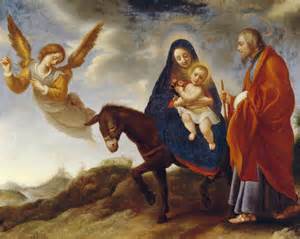
Out of the four Gospel writers, only Matthew has recorded the events of escaping into Egypt and killing the innocent boys in Bethlehem.[1] From a human perspective, this particular biblical narrative is dark, demonic, deadly, and devastating. Yet there is a turning point, a climax of the story, a defining moment in this portion of the redemptive history.
The central theme here is that God will always win, and Christ the King cannot be eliminated because he is matchless, unrivaled, and incomparable. And to see all of that as a whole picture is like putting the pieces of puzzles together. And each part of the puzzle is an important event when putting it together collectively with other details to give a glorious picture of Jesus and the theme of Christmas. And that is the goal of this sermon. Let us begin with the first event.
1. Intervention by God (v. 13)
Notice God’s intervention by his revelation for his provision and protection. That is a loaded sentence!
God reveals his plan to Joseph through an angel of the Lord in a dream. This is the second dream in which Joseph received God’s intervention by revelation (1:20). However, this is the third dream in Matthew’s Gospel so far in which God’s plan is revealed through a dream (1:20; 2:12).
What’s happening in our text is descriptive, not prescriptive. Matthew is merely describing a historical account here, not prescribing for us to know God’s will through dreams. It is not a normative practice for Christians to seek dreams for God’s will. What is happening in Matthew 2 was during a particular time when the Bible wasn’t complete. But now, if you want to know God’s objective will, then seek God’s word instead. The word of God is far more superior and sure than dreams and visions (WCF 1.1).
The purpose of God’s intervention is not only to protect Joseph and his wife Mary from Herod but, most importantly, for God the Father to protect his Son, Jesus. So, an angel of the Lord commanded Joseph to take the child and the mother and flee to Egypt.
Isn’t God’s timing perfect? God intervenes when he sees the need.
Today God is still in the business of intervention with his revelation every week, namely through the preaching of his word. And why? Like this narrative, for provision and protection.
2. Obedience of Joseph (vv. 13-15a)
God’s commands to Joseph are clear in four words in verse 13: “Get up, take, flee, and remain.” Those are not God’s four suggestions, but God’s four commands. And Joseph’s obedience is clearly seen in verse 14: “So Joseph got up, took, and left.” In verse 15, the text reads: He remained there until the death of Herod. Joseph represents what Christians do – obedience to God’s word.
According to Calvin, the fact that Joseph obeyed God’s commands and stayed in the foreign land until Herod’s death shows the perseverance of Joseph’s faith.[2] Also, Charles Spurgeon said, “The Lord’s servants must wait for the Lord’s word before they make a move, whether it be to go abroad or to come home. Waiting is hard work, especially waiting in Egypt, but it is safe to tarry till we have our marching orders.”[3]
Joseph represents what Christians do – obedience to God’s word. When you learn God’s truth, you must faithfully, joyfully, and immediately obey them. And you obey, especially when things are difficult. Your obedience to God is not based on how you feel. Your obedience to God is based on what he says in the Bible.
In what ways are you obeying God’s word at this time?
Are you faithfully committed to keeping the Lord’s Day holy by gathering with God’s people every week? Or do you allow other things to take precedence? What part of “do not forsake assembling together, as is the habit of some” in Hebrews 10:25 you do not understand? What kind of message do you give to others when you allow work, recreation, and other things to come before worshipping God on the Lord’s Day with your local church? In what ways are you obeying God’s word?
In what ways are you obeying God’s word about being committed to learning and studying God’s word? Why aren’t you taking advantage of Friday Night Bible Study and/or Foundations of Faith class? What part of “Study to show yourself approved unto God, a workman that needs not to be ashamed, rightly dividing the word of truth” in 2 Tim. 2:15 do you not understand, yet you want to be a leader?
In what ways are you training up your children and modeling for them? Prov. 22:6 says, “Train up a child in the way he should go.” In what ways are you training up your child in the way he/she should go regarding how to worship God, how to pray, how to listen to God, how to serve God in the context of the local church?
In what ways are do you support and submit to the spiritual leadership that God has sovereignly placed you under? In what way do you have accountability with your pastor? Or do you listen more and support others who are not your pastor? What part of “Obey your leaders and submit to them, for they keep watch over your souls as those who will give an account. Let them do this with joy and not with grief, for this would be unprofitable for you” in Heb. 13:17 you do not understand?
3. Fulfillment of the Prophecies (v. 15b)
One of the keywords in Matthew’s Gospel is “fulfilled.” Matthew uses this verb repeatedly throughout his writing. The reason for this repeated emphasis is to show how the fulfillment of what God promised in the OT came about. And you see that throughout Matthew. Here in our text alone, he mentions three OT fulfillments (vv. 15, 17, 23).
Perhaps this is a good place to mention the NT interpretation of the OT briefly. In other words, how do the NT writers interpret the OT? For instance, in verse 15, how did Matthew use Hosea 11:1 to mean the fulfillment of prophecy concerning the Messiah? Granted, the writers were under the inspiration of the Holy Spirit. But how do we today interpret the OT in light of the NT?
In Bible interpretation, one of the things to pay attention to is identifying and interpreting “types.” Typology is when “the NT looks back to a number of persons, things, and events in the OT and treats them as foreshadowing then-future persons, things, and events.”[4] More than 10 percent of the NT is made up of citations or direct allusions to the OT. By quoting the OT frequently, the NT writers demonstrated their trust and confidence in the OT.[5]
Sometimes the NT writers referred to individuals, things, and events in the OT and then stretched those texts or contexts beyond their original historical setting to refer to Christ. And such is the case in Matthew 2:15. Historically and contextually, Hosea 11:1 is a reference to Israel, which is also called God’s son in Exodus 4:22. But Matthew goes beyond the historical and contextual setting to give Christological or Christ-centered interpretation using Israel as a type of Christ. According to D.A. Carson, “The NT writers insist that the OT can be rightly interpreted only if the entire revelation is kept in perspective as it is historically unfolded.”[6] And this method of Bible interpretation is called the redemptive-historical approach. That is to say, interpret the Scripture in light of the gospel and Christ. That is what a Christ-centered interpretation is. Jesus said in John 5:39 that the Scripture testifies about him. After all, Jesus is the center of the entire redemptive history of the Scripture. Another way to look at it is that the OT is the preview of the NT, whereas the NT is the OT’s fulfillment.
4. Demonic Extermination (vv. 16-18)
Even though Herod is an unbeliever, Herod’s action in Matthew 2:16 goes beyond the standard of what non-Christians do. That is to say, even in the eyes of unbelievers, what Herod did is evil and wicked like Hitler.
Isn’t it interesting that even those who reject the notion of absolute and objective truth, such as non-Christians, do have specific standards of morality? In other words, even non-Christians who reject the moral standards of biblical teaching do have standards of what is evil and wicked like Hitler?
How do we Christians explain when some people like Hitler, Herod, and others do evil and wicked things beyond what non-Christians do? According to Scripture, this kind of evil act is influenced outside of an unbeliever’s normative behavior. In other words, this action is beyond depraved mind, but demonic. In John 8:43-44, Jesus speaking to the Pharisees, made this jaw-dropping comment:
NAU John 8:43 “Why do you not understand what I am saying? It is because you cannot hear My word. 44 “You are of your father the devil, and you want to do the desires of your father. He was a murderer from the beginning, and does not stand in the truth because there is no truth in him. Whenever he speaks a lie, he speaks from his own nature, for he is a liar and the father of lies.
Peter also said, “Be of sober spirit, be on the alert. Your adversary, the devil, prowls around like a roaring lion, seeking someone to devour” (1Pet. 5:8).
At the end of the day, Herod is responsible for his own wicked actions. At the same time, there is a demonic influence that cannot be ignored. Biblically and historically, some individuals have been demonically influenced to stop God’s plan and the work of God. The Scripture is clear:
NAU Ephesians 6:12 For our struggle is not against flesh and blood, but against the rulers, against the powers, against the world forces of this darkness, against the spiritual forces of wickedness in the heavenly places.
What we see in Matthew 2:16 is a horrific picture of the demonic extermination of innocent Jewish boys under the age of two. Flashing swords, screaming moms, flowing drops of blood are the dark side of the Christmas story.[7]
The Christmas carol “O Little Town of Bethlehem, how still we see thee lie” is not the case, but now, “O Little town of bedlam (chaos), how deep we hear thy cry.” It is no longer shepherds running through the streets, but now soldiers marching in the streets. The joy of peace on earth is now replaced by piercing swords. The silent night became a screaming night. The blood is flowing, babies are dying, and the parents are weeping. That’s the dark side of Christmas.[8] According to Matthew, this is another fulfillment of the OT prophecy, namely from Jeremiah 31:15, which says:
Thus says the LORD,
“A voice is heard in Ramah,
Lamentation and bitter weeping.
Rachel is weeping for her children;
She refuses to be comforted for her children,
Because they are no more.”
According to a Bible commentator, Rachel’s tomb was near Bethlehem. And Rachel was considered by many to be the mother of the nation of Israel. That is why she is seen weeping over these children’s deaths.[9]
5. The Divine Elimination (vv. 19-20)
Like verse 13, we see here God’s intervention. But this time, it is God’s intervention by elimination, namely the elimination of Herod. Verse 19 says Herod died.
The lesson here is that no one (including evil ruler or demonic influence) can frustrate the will of God. God’s plan cannot be frustrated or hindered by anyone. God will always accomplish his sovereign plan and purpose. And God will always eliminate anyone who tries to hinder God’s work and plan.
NIV Isaiah 13:11 I will punish the world for its evil, the wicked for their sins. I will put an end to the arrogance of the haughty and will humble the pride of the ruthless.
Notice the contrasts between Herod the king and Jesus, the king:
Herod, an epitome of a selfish and self-indulgent ruler; Jesus, a self-denying and self-sacrificing ruler.
Herod, ruled by Satan. Jesus, the ruler of Satan.
Herod the destroyer. Jesus the Savior.
Herod, the cruel murderer of little ones. Jesus, the one who calls little ones to him.
Herod, in the end, losing all. Jesus, still in control overall.[10]
6. Supremacy of Jesus Christ (vv. 21-23)
In his writing, Matthew repeatedly points out the supremacy of Jesus Christ over everyone, including his mother, Mary. For example, in verse 11, it was to Jesus the worship is directed, not to Mary. It was to Jesus the gifts were presented, not to Mary. This type of example is shown throughout Matthew’s writing, especially how Jesus is mentioned first and before his mother, Mary. Not once Mary is mentioned or preferred before Jesus (vv. 13, 14, 20, 21).
All that to say, Matthew’s goal in his writing is to show the supremacy of Jesus Christ. But that’s not only true in Matthew 2. You recall in the genealogy how Christ is better and superior to anyone else. For instance, Jesus Christ is mightier and better king than David. Jesus is more faithful than Abraham, the father of covenant faith. Jesus is wiser than Solomon. Jesus is supreme over everyone that is mentioned in the genealogy. Jesus is the greatest in all history. We don’t need dreams or visitations from an angel to believe all of that because we have more sure revelation because we have the words of Christ.
Furthermore, according to Matthew 2, Jesus Christ crushed the demonic influence and plans of Herod. No man, no power, no force is a match to our Lord Jesus Christ. Herod thought he could eliminate Jesus. But guess what? He got eliminated! In this world, there are only two wills: God’s will and man’s will. Guess what? The will of God always prevails. The story’s central theme is that God will always win, and Christ the King cannot be eliminated because he is matchless, unrivaled, and incomparable. And that is perhaps the most important lesson that Christmas teaches.
I would like to echo the words of Paul regarding the supremacy of Christ in Colossians 1:15-18. It says:
NAU Colossians 1:15 He is the image of the invisible God, the firstborn of all creation. 16 For by Him all things were created, both in the heavens and on earth, visible and invisible, whether thrones or dominions or rulers or authorities– all things have been created through Him and for Him. 17 He is before all things, and in Him all things hold together. 18 He is also head of the body, the church; and He is the beginning, the firstborn from the dead, so that He Himself will come to have first place in everything.
Do you know him? Would you like to know him, the main reason for this season?
8 But what does it say? “THE WORD IS NEAR YOU, IN YOUR MOUTH AND IN YOUR HEART” — that is, the word of faith which we are preaching, 9 that if you confess with your mouth Jesus as Lord, and believe in your heart that God raised Him from the dead, you will be saved; 10 for with the heart a person believes, resulting in righteousness, and with the mouth he confesses, resulting in salvation. 11 For the Scripture says, “WHOEVER BELIEVES IN HIM WILL NOT BE DISAPPOINTED.” 12 For there is no distinction between Jew and Greek; for the same Lord is Lord of all, abounding in riches for all who call on Him; 13 for “WHOEVER WILL CALL ON THE NAME OF THE LORD WILL BE SAVED.”




 Pastor's Perspective